Table of Contents
The Tenth House in Horary: Career, Authority, and Public Standing
The tenth house sits at the very top of the chart, and that position is not decorative. It is the highest point a planet can occupy, and it governs the highest things in a person's life: power, career, recognition, and standing in the eyes of the world.
Where the ninth house looks toward the Divine, the tenth looks toward the ones who rule over us here on earth — and toward our own place among them.
Whoever Holds the Power
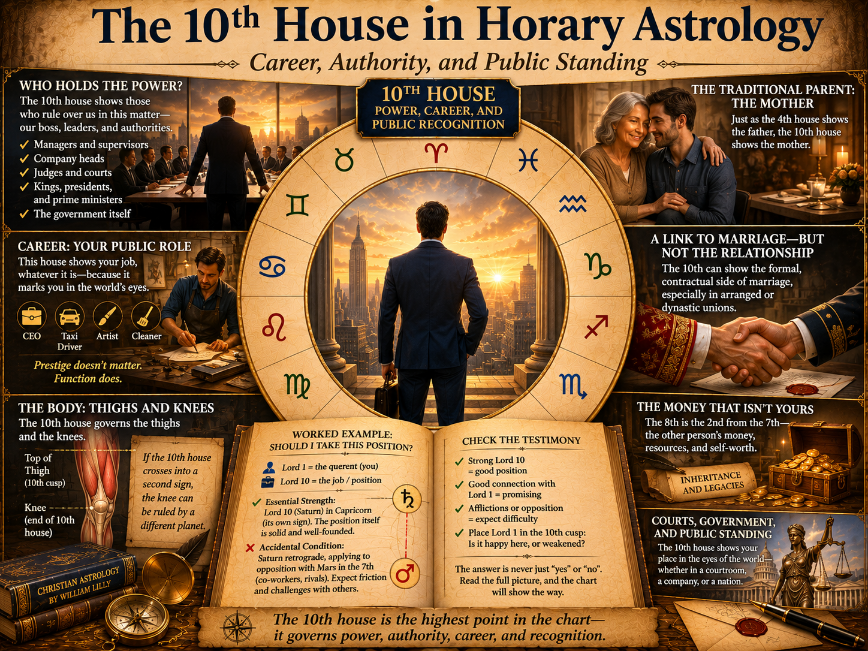
At its simplest, the tenth house shows the boss. But "boss" needs to be read broadly, because the house covers every level of authority a question might involve:
- A manager or supervisor
- The head of a company
- A judge, or the court system as a whole
- A king, president, or prime minister
- The government itself
The rule underneath all of these is the same: this house belongs to whichever party sits above the querent in this particular matter. Questions like "Will I be promoted?", "Will I win Olympic gold?", or "Will I be recognised for this?" all live here, because they all concern rising or falling in the eyes of the world.
Career, Regardless of How You Feel About It
Whether the querent is a chief executive, a taxi driver, a self-employed artist, or a cleaner, this house shows their job — not by ranking its prestige, but by its function. If it produces a public role and marks the querent in the world's eyes, it is tenth-house. Whether the querent loves the work or resents every hour of it is irrelevant to the house it belongs in. That emotional colour comes from elsewhere in the chart. The house itself is neutral: it simply asks, is this the querent's public role?
The Traditional Parent
In the traditional system, the tenth house signifies the mother, just as the fourth signifies the father. Modern astrology sometimes debates this pairing, but for horary purposes, the assignment is fixed: a question about "my mum" is read from the tenth.
A Quiet Connection to Marriage
There is a subtler link worth knowing: the tenth touches marriage, but only its formal, contractual dimension — not the relationship itself. This surfaces in questions about arranged or dynastic unions, where the marriage serves a public or family duty rather than private affection. The relationship as felt experience always remains seventh-house. It is only the deal, or the duty behind the deal, that can reach into the tenth.
The Body: Thighs and Knees, and Where the Line Falls
Physically, the tenth house rules the thighs and the knees, and the way this plays out is a small but genuinely useful piece of precision.
The cusp of the tenth marks the top of the thigh. The end of the house — right before the eleventh cusp begins — marks the knee. Most of the time this sits cleanly within one sign and one ruler. But when the tenth house crosses a sign boundary, the two body parts can end up ruled by two different planets entirely.
Take an example: the tenth cusp falls at 8° Aries, and the eleventh cusp falls at 15° Taurus. Mars, ruling Aries, governs the top of the thigh. But Venus, ruling Taurus, governs the knee — because the knee sits at the end of the house, in the second sign the house passes through, not the first. In a medical question about a querent's knee, this is the difference between reading Mars and reading Venus, and it matters.
A Worked Example: "Should I Take This Position?"
Here is a scenario built specifically to show how this house behaves — not a real reading, but constructed to demonstrate the method cleanly.
The question: A querent has been offered a role and is deciding whether to accept it. Note immediately that this is a different question from "Will I get the job?" — that question assumes the job is not yet secured. "Should I take it?" assumes it already is, and asks instead what the experience of it will be like.
Setting the significators. The querent is Lord 1. The job itself is Lord 10.
Essential condition of the job. Suppose Lord 10 is Saturn, found in Capricorn — its own sign, strongly dignified. Essentially, then, this is a sound position: not a house of cards, not built on nothing.
Accidental condition. But suppose that same Saturn is also retrograde, and applying to an opposition with Mars, which sits in the 7th house (representing the querent's future co-workers or rivals for standing within the role). Here is where the reading gets interesting: essential strength does not guarantee accidental comfort. The job itself, in its bones, is solid — but retrograde motion and an opposition to the 7th suggest real friction is coming, and possibly some reversal or delay in how the role unfolds, along with genuine difficulty with the people the querent will be working alongside.
Dropping the querent's significator into the house. One more technique worth showing here: mentally place Lord 1 just inside the 10th cusp, as though sending the querent to work, and see how it fares there. If Lord 1 finds itself in a sign where it holds strong dignity, the placement is a happy one. If it lands somewhere it is weakened — in its detriment or fall, say — the discomfort is immediate and visible, independent of anything else in the chart.
Reading it together. The judgement here isn't a flat yes or no — because "should I take it" rarely deserves one. It's closer to: the position itself is genuinely solid, but expect friction with the people around you, and don't be surprised if the early months feel like a struggle before it settles. That is a far more useful answer than "yes" or "no" alone, and it's exactly the kind of nuance this house is built to deliver, provided you look past the simple presence or absence of an aspect and into its full accidental picture.
The Practical Takeaway
The tenth house asks a single underlying question in many different outfits: what does the world see when it looks at this person, and who stands above them in this matter? A boss, a monarch, a judge, a career, an Olympic medal — all different answers to the same question about public standing and authority.
Learn to ask that one question first, and the house stops being a list to memorise. It becomes a lens you can point at almost any situation involving power, recognition, or public role — and trust it to show you something true.
Continue with The Eleventh House in Horary: the house of friends, hopes, and the alliances we choose rather than inherit.
For the complete method these house judgments plug into, see the 5 Golden Rules of Horary Astrology. For how all twelve houses relate to each other at a glance, Master the 12 Houses of Horary Astrology is the reference page to keep close by.
No comments yet.