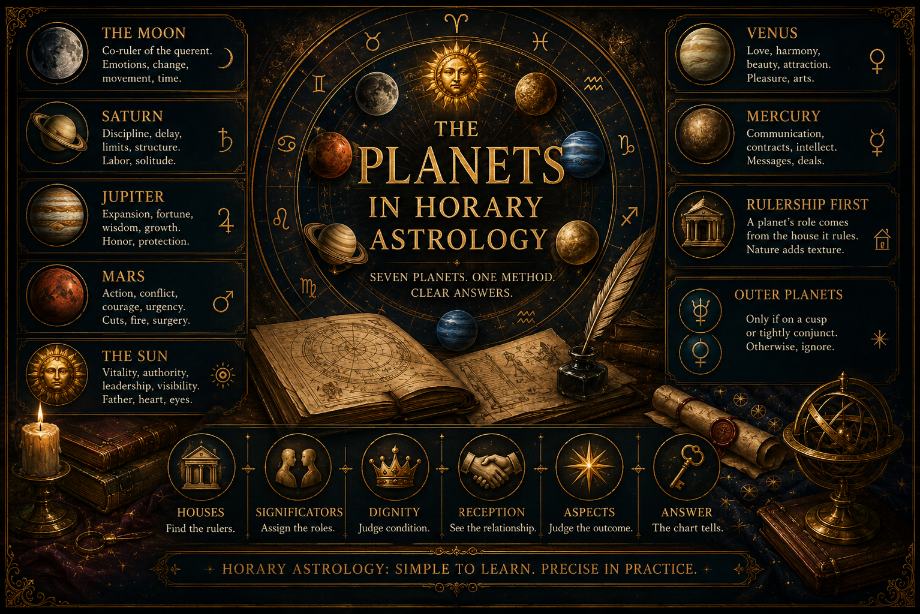
Table of Contents
- The Moon: Co-Ruler of the Querent
- Saturn: Discipline, Delay, and Structure
- Jupiter: Expansion, Fortune, and Favorable Outcomes
- Mars: Action, Conflict, and Urgency
- The Sun: Vitality, Authority, and Visibility
- Venus: Love, Harmony, and Attraction
- Mercury: Communication, Contracts, and Intellect
- Planetary Rulerships vs. Natural Significations
- Uranus, Neptune, and Pluto: Do the Outer Planets Apply?
- Where to Go From Here
The Planets in Horary Astrology: A Complete Guide to Every Significator
Every horary chart is read through seven traditional planets — the Sun, the Moon, Mercury, Venus, Mars, Jupiter, and Saturn. Nothing else in the sky carries a vote. Uranus, Neptune, and Pluto sit outside the system entirely, brought in only under a narrow exception; Chiron, the asteroids, and every other modern addition to the chart don't apply at all.
But here is the idea that trips up nearly everyone coming to horary from natal astrology: a planet's meaning isn't fixed. Venus doesn't always mean love. Mars doesn't always mean conflict. In this method, a planet's primary role comes from the house it rules in this chart, for this question — and only after that role is assigned does the planet's natural character add texture to the reading. The full logic behind that ordering — and why it matters so much — is covered in Planetary Rulerships vs. Natural Significations in Horary, which is worth reading before or alongside this guide.
This page is the reference. Below, you'll find one section for each of the seven traditional planets, plus the Moon's unusual double duty as co-significator of the querent, and a final section on where — if at all — the outer planets fit in. Each section is a short summary; the full article for each planet goes much deeper into dignity, worked examples, and how to read it strong or weak.
The Moon: Co-Ruler of the Querent
Six of the seven traditional planets follow the same rule: find the house they rule, read their condition, move on. The Moon breaks that pattern. In nearly every horary chart, the querent has two significators, not one — the ruler of the 1st house (Lord 1), and the Moon riding alongside it as co-significator. Lord 1 shows the querent's role in the situation. The Moon shows how the querent feels about it.
That's only true, though, when the Moon isn't already busy playing a different part. If the Moon rules the house of the very thing being asked about — the quesited — it belongs to that matter instead, and the querent works with Lord 1 alone. The Moon also never shifts to represent a third party; even in a question about someone else entirely, the Moon stays with the person actually asking. Beyond its co-significator role, the Moon's speed and changeability give it natural rulership over anything defined by movement or flux — travel, messages, the public at large, and the passage of time within the question itself.
Read the full breakdown, including how to weigh the Moon's aspects against Lord 1's, in The Moon in Horary Astrology: Why It's a Co-Ruler, Not Just Another Planet.
Saturn: Discipline, Delay, and Structure
Saturn is cold, dry, and diurnal — the planet of weight, limits, and time. Find it ruling a significator and the instinct is to assume bad news. Resist that instinct. Saturn dignified describes patience, endurance, and quiet self-control; the same planet afflicted turns toward fear, bitterness, and isolation. The difference is condition, not identity.
By natural rulership, Saturn governs labor that's solitary, low-status, or tied to the ground — miners, gravediggers, farmhands, monks and hermits. Physically, Saturn people tend to be tall but stooped, dark-haired, with a serious expression that rarely breaks into a smile. On the body, Saturn rules conditions that are slow and lasting rather than sudden: arthritis and joint disease, chronic skin complaints, and melancholy.
The full article works through a real example — a stalled negotiation, and how the same Saturn placement reads completely differently depending on dignity. Read it at Saturn in Horary: Discipline, Delay, and Structure.
Jupiter: Expansion, Fortune, and Favorable Outcomes
Jupiter is hot, moist, and diurnal — one of horary's two traditional fortunes, and the planet where a chart opens up rather than contracts. But "fortune" isn't the same as "automatic yes." A strong, dignified Jupiter describes real generosity, sound judgment, and honest leadership. A poorly-placed Jupiter can just as easily show wastefulness, performative faith, or an eagerness to please that costs the person their own self-respect.
By natural rulership, Jupiter governs judges, priests, professors, and anyone occupying a position of genuine social standing. Physically, Jupiter people tend to be tall and straight-backed with a full face and warm coloring. On the body, Jupiter's health signatures come from excess rather than deficiency — liver and blood disorders, inflammation, circulatory swelling.
The full article walks through why a strong Jupiter still needs its condition checked before you call a business partnership favorable. Read it at Jupiter in Horary: Expansion, Fortune, and Favorable Outcomes.
Mars: Action, Conflict, and Urgency
Mars is hot, dry, and nocturnal — the planet most people assume is simply "bad" to find ruling a significator. That assumption doesn't hold up. Mars ruling your significator in a court case or a surgery isn't automatically a warning; it's often exactly what the question needs. A strong, dignified Mars shows courage and decisive action — the protector, not the aggressor. Weak or afflicted, that same energy turns into aggression without a target: recklessness, escalation, conflict for its own sake.
By natural rulership, Mars governs soldiers, surgeons, firefighters, and anyone whose work involves blades, fire, or genuine physical risk. On the body, Mars rules conditions that arrive fast and hot — burns, cuts, fevers, inflammation — matching its refusal to sit still.
The full article includes a worked surgery question, showing exactly how to separate Mars's natural association with blades from what the chart's actual house rulership tells you. Read it at Mars in Horary: Action, Conflict, and Urgency.
The Sun: Vitality, Authority, and Visibility
The Sun is hot, dry, and diurnal — and it matters exactly as much as the chart assigns it, no more automatically important than any other planet just because it's the Sun. What it always brings, wherever it lands, is visibility. A dignified Sun describes an honest leader: confident, respected because respect has been earned. An afflicted Sun is Frawley's "burnt-out star" — all the appearance of status, none of the substance underneath.
By natural rulership, the Sun governs kings, magistrates, and anyone whose authority is public record rather than private influence, along with goldsmiths and those who work in precious metals. On the body, the Sun rules the heart, the brain, and the eyes — the body's vital center rather than its edges.
The full article works through a father-approval question that shows exactly why you check house rulership before reaching for the Sun's natural association with authority. Read it at The Sun in Horary: Vitality, Authority, and Visibility.
Venus: Love, Harmony, and Attraction
Venus is cold, moist, and nocturnal — a lesser fortune, generally beneficial wherever she has a genuine role. But "soft" doesn't mean "decorative." Venus ruling your significator in a relationship question is a direct testimony, deserving the same careful reading as Mars or Saturn. Dignified, she describes real warmth and genuine goodwill. Afflicted, that same pleasure-seeking turns toward overindulgence, unfaithfulness, or a connection built on good feeling rather than reliability.
By natural rulership, Venus governs artists, musicians, jewelers, and anyone whose work centers on beauty or pleasure. On the body, she rules the reproductive system and conditions linked to overindulgence rather than sudden injury.
The full article shows Venus ruling an employee in a workplace question — proof that her natural warmth colors whatever role she's handed, romantic or not. Read it at Venus in Horary: Love, Harmony, and Attraction.
Mercury: Communication, Contracts, and Intellect
Mercury's nature is genuinely mixed — masculine or feminine, favorable or troublesome, depending entirely on what it's near in the chart. Its core theme is the mind in motion: thinking, negotiating, connecting, and, when poorly placed, deceiving. Well-placed, Mercury shows quickness without confusion — someone sharp, curious, a natural negotiator. Poorly placed, the same speed becomes a liability: talking too much, believing whatever's said last, spreading rumors without checking them.
By natural rulership, Mercury governs writers, lawyers, accountants, and messengers — and, less flatteringly, thieves and pickpockets, since the common thread is dexterity rather than virtue. Mercury's clearest domain among things is documents: contracts, letters, records, anything written down and passed between hands.
The full article explains why Mercury deserves a look in a lost-paperwork question even when it isn't ruling the relevant house. Read it at Mercury in Horary Astrology: Communication, Contracts, and Intellect.
Planetary Rulerships vs. Natural Significations
This is the article that ties every planet above together. In horary, a planet acquires meaning in exactly two ways: through the house it rules (the far more important of the two), and through its natural associations, which only ever add secondary texture. Every house has exactly one ruler — there is no such thing as a co-ruler in traditional horary — though the same planet can sometimes end up ruling two different things in the same chart, which is where techniques like the next-sign substitution come in.
This article also covers the narrow exception that allows a non-ruling planet to stand in as significator, and closes with a practical exercise for building fluency in natural signification: taking an everyday object and asking what its essential planetary nature actually is.
Read the full article at Planetary Rulerships and Natural Significations in Horary Astrology.
Uranus, Neptune, and Pluto: Do the Outer Planets Apply?
The honest, traditional answer: not the way modern astrology has probably taught you to think about them. Horary judgment rests entirely on the seven traditional planets above. Uranus, Neptune, and Pluto rule no signs and carry none of the essential dignity the classical seven do — bringing them into a chart the way natal astrology treats them will consistently produce the wrong answer.
That doesn't mean they're irrelevant in every case. Treat them the way you'd treat a fixed star: worth checking only when one sits directly on a relevant house cusp, or forms a tight conjunction with a significator already central to the question. Under that narrow condition, Uranus signifies sudden breaks and disruption, Neptune signifies illusion and deception, and Pluto adds pressure or intensity — though it's the least precise of the three. Outside that condition, all three contribute nothing but noise, and the same restraint applies to Chiron, the asteroids, and every other modern addition to the chart.
Read the full case for this — including a real divorce chart where Uranus and traditional Mars confirmed the same testimony independently — at Uranus, Neptune, and Pluto in Horary: Do the Outer Planets Even Apply?
Where to Go From Here
The planets are the actors in every horary chart, but they only make sense once you know which stage they're standing on. If you haven't already, start with Master the 12 Houses of Horary Astrology to see exactly which cusps hand each planet its role in a given chart — and the 5 Golden Rules of Horary Astrology for the full method these significators operate inside: radicality, significators, dignity, reception, and aspects, in sequence.
Once the framework is in place, the fastest way to make any of this automatic is to test it against a real question. Cast a free horary chart with something you actually want answered, find your significators, and work through dignity the way each article above describes. If you'd rather have the chart read for you, book a reading and the same Lilly and Frawley method gets applied by hand to your specific question. And if you're working a different kind of divination question entirely, the geomancy chart tool runs on the same principle of letting the method — not the assumption — decide the answer.
No comments yet.